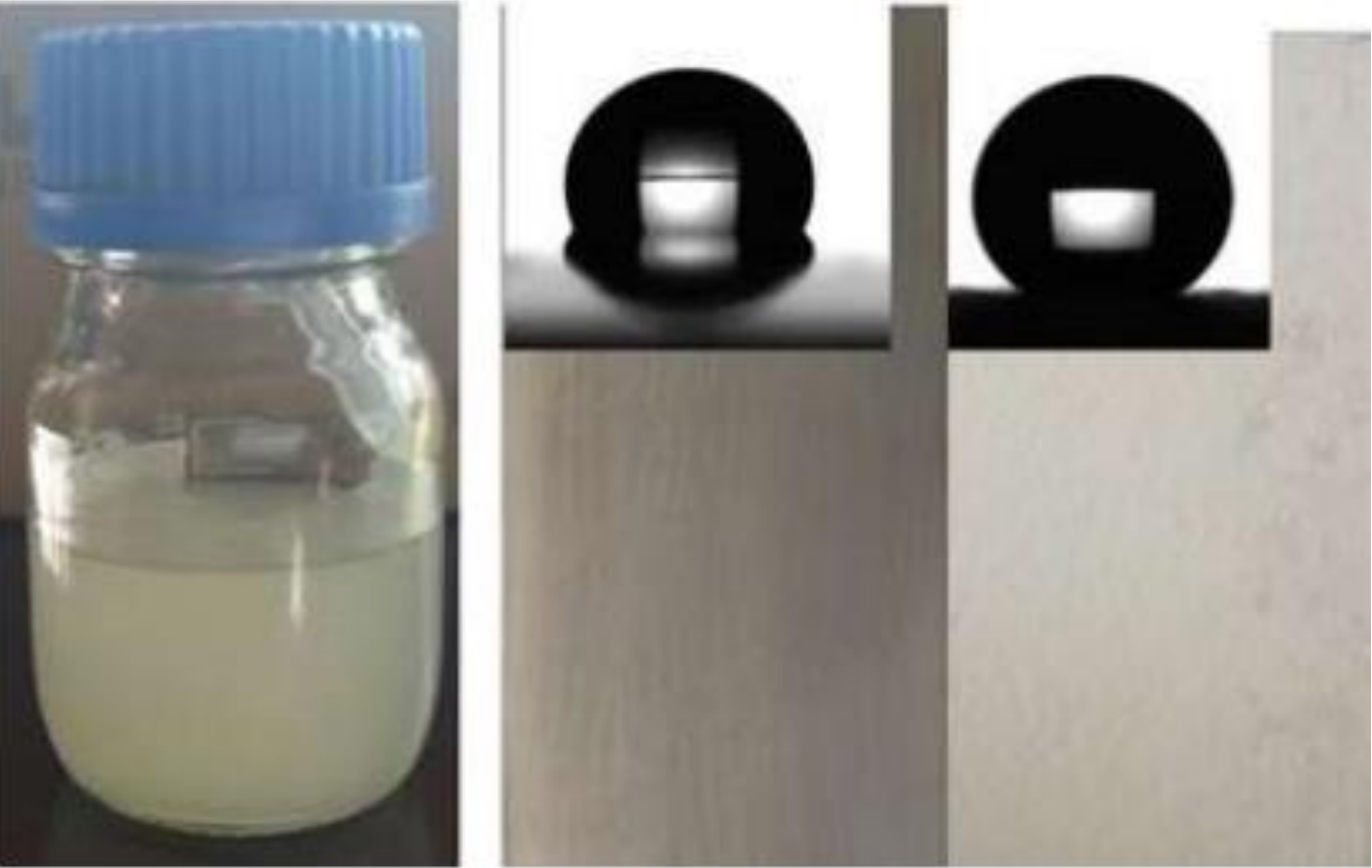
Variations in the wettability of nanolubricants, which crucially influence tribological performance, are driven by physical factors such as substrate morphology, material composition, surface tension, and lubricant viscosity. In the study, the tert-butylhydroquinone-modified silver/carbon black (Ag@CB) nanoparticles are employed to develop an effective lubricant. Herein, the influence of nano-Ag@CB concentration, surface tension, oil viscosity, and substrate morphology on the surface wettability is explored by quantifying the contact angle in experimental and molecular dynamics simulation results. The maximum deviation between experiment and simulation is 4.2%. It is jointly verified that the strong adsorption effect, driven by the high synergy between hybrid nanoparticles, optimally enhances the wettability of the composite nanolubricant by 54.2%, with a minimum contact angle of 22.4 °, compared to single additive and basic lubricant. The effect on tribological performance is investigated by innovatively varying the wettability of the friction sub-materials. By analyzing mean square displacement, radial distribution function, energy profiles, microscopic atomic motion trajectories, and adsorption processes, the underlying mechanisms for the wettability enhancement of nano-bio-lubricants are elucidated. The results of this study can shed lights on the design of nanolubrication with high wettability and superior lubricating properties.
周老师: 13321314106
王老师: 17793132604


邮箱号码: lub@licp.cas.cn




 润滑剂
润滑剂
 润滑油添加剂
 自润滑材料
自润滑材料
 密封材料
密封材料
 新兴材料
新兴材料
 加工设备
加工设备
 摩擦试验机
摩擦试验机
 大型表征仪器
 小型测试设备