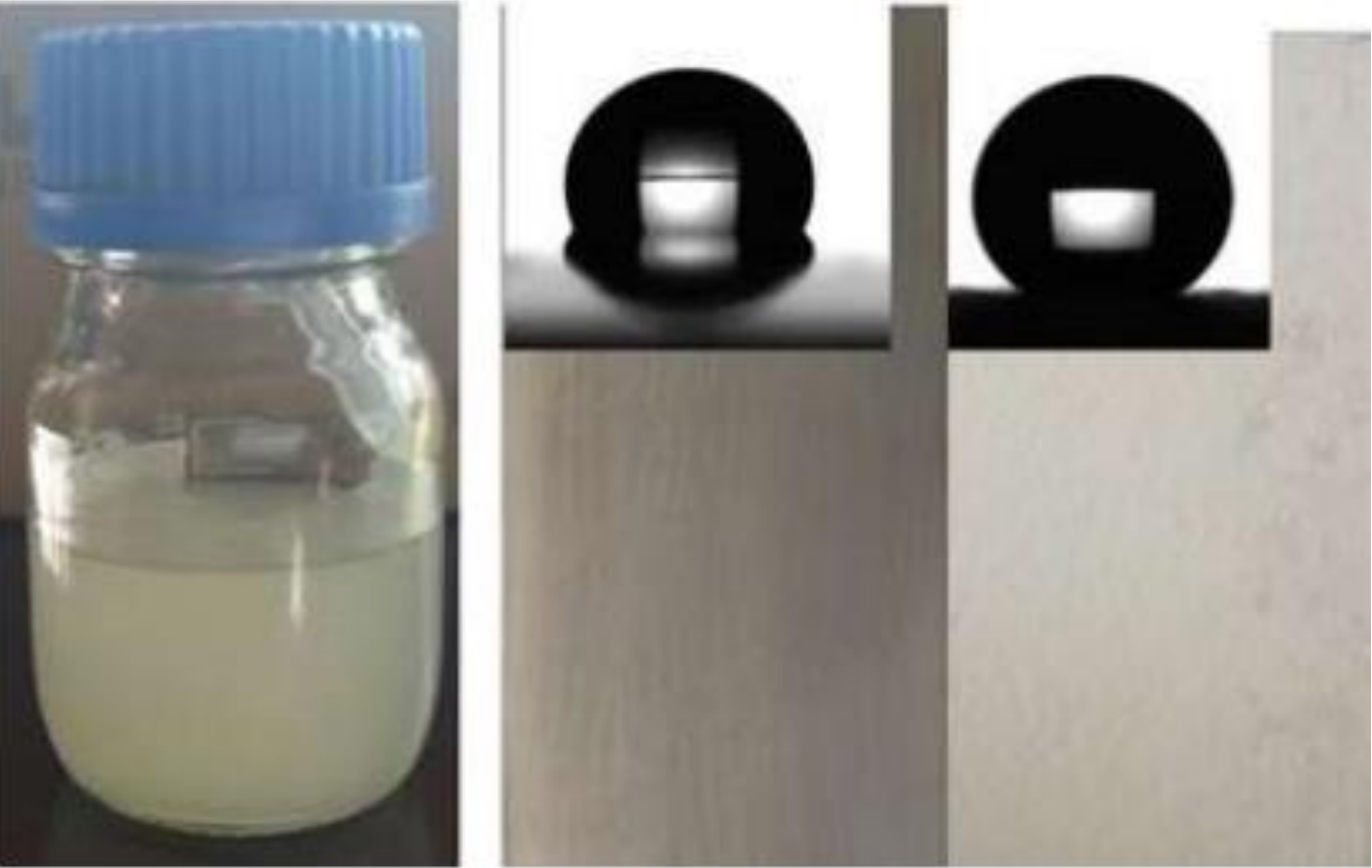
Elucidating the coupling between oil viscosity and interfacial sliding dynamics is critical for tribological advancements. To this end, a liquid-infused surface with low friction coefficient and efficient water droplet detachment was developed, and characterization results showed it exhibited superhydrophobic behavior, as evidenced by a contact angle of over 150°. Its interfacial synergistic regulation mechanism was revealed to address wear in humid environments. In this study, water droplet sliding behavior and tribological properties on aluminum surfaces lubricated with three kinds of dimethicone oils (~ 10 mPa·s, ~ 20 mPa·s and ~ 100 mPa·s at 25 °C) were systematically evaluated using a custom vacuum glovebox and tribometer. Viscosity-dependent kinetic behaviors across pressures from 101.3 kPa (ambient) to 31.3 kPa and tribological behaviors at rotational speeds of 20-50 rpm and loads of 0.5-2.0 N were investigated. Dual mechanisms governing droplet sliding velocity and tribological performance by dimethicone viscosity were revealed: lower vacuum pressure increased effective lubricant viscosity, slowing sliding, while higher oil viscosity universally hindered velocity. Analysis between sliding velocity and dynamic viscosity was established, highlighting rheological dominance over pressure effects. The friction coefficient decreases with increasing load (enlarged contact area and higher lubricating film load proportion) and rotational speed (continuous lubricating film formation and shear-induced resistance reduction). These findings refine lubrication models by prioritizing viscosity-dependent fluid properties, offering design principles for high-performance lubrication systems in ambient and low-pressure environments.
周老师: 13321314106
王老师: 17793132604


邮箱号码: lub@licp.cas.cn




 润滑剂
润滑剂
 润滑油添加剂
 自润滑材料
自润滑材料
 密封材料
密封材料
 新兴材料
新兴材料
 加工设备
加工设备
 摩擦试验机
摩擦试验机
 大型表征仪器
 小型测试设备